
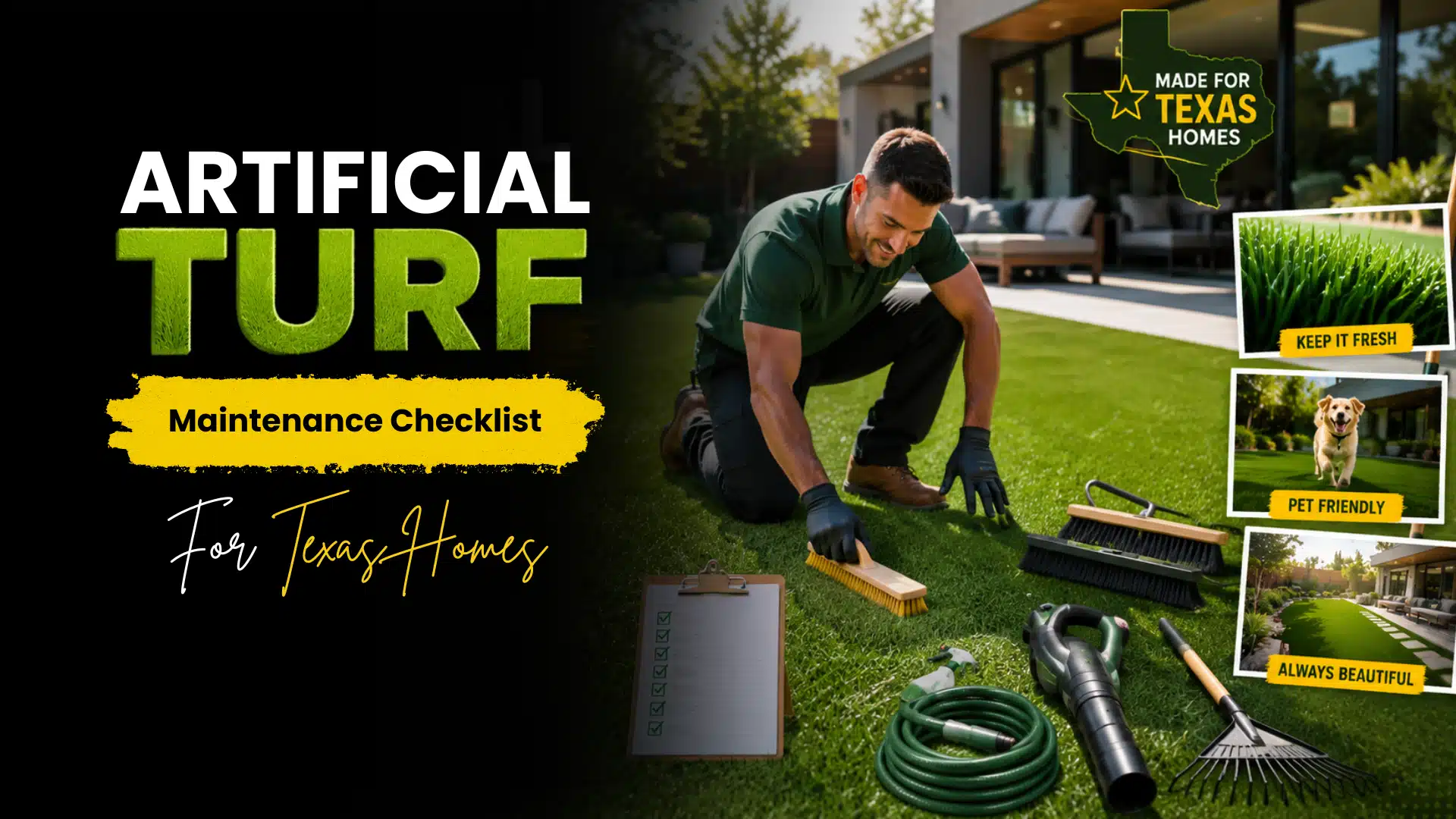
TL;DR
- What does a complete Texas turf maintenance routine include? Daily pet rinsing, weekly brushing, monthly infill checks, quarterly and annual professional visits.
- What do most checklists miss? Spring pollen clogs Texas infill drainage within 2 to 3 weeks if not rinsed weekly.
- When do I need a professional instead of DIY? Once odor returns within 48 hours after rinsing, uric acid has already bonded.
- What products are safe to use? Stiff-bristle push brooms only; wire brushes and bleach damage turf fibers.
QUICK ANSWER BOX
An artificial turf maintenance checklist for Texas homeowners follows five frequency tiers based on climate, not generic national timelines. Dallas and Fort Worth summers above 105°F bond pet uric acid to infill within 72 hours, faster than most checklists assume.
| Frequency | Core Task |
| Daily (pet owners) | Rinse urine spots |
| Weekly | Brush fibers, remove debris |
| Monthly | Check infill level, deodorize |
| Quarterly | Professional deep clean |
| Annually | Infill inspection, full sanitization |
A complete checklist covers five frequency tiers: daily, weekly, monthly, quarterly, and annual tasks, each tied to a specific reason rather than a fixed calendar. Texas heat above 105°F bonds pet uric acid to infill within 72 hours, a seasonal pressure most national checklists were never written to handle.
The five tiers exist because Texas turf faces compounding stress that mild climates do not. Daily rinsing matters for pet owners because heat speeds uric acid bonding to infill, while weekly brushing counters fiber flattening from heavy foot traffic and pollen buildup. Monthly checks catch infill compaction before it becomes structural, and quarterly or annual professional visits handle decompaction and sanitization that brushing alone cannot reach. The clearest entry point for any Texas household is the daily-versus-weekly split, since pet exposure changes the entire schedule.
Pet owners need to rinse urine spots with water daily, ideally within minutes of use during summer months. Dallas and Fort Worth heat above 105°F bonds uric acid to infill fibers within 72 hours, after which water rinsing alone stops working. A daily rinse routine slows that bonding window, but it does not break down compounds already trapped below the surface layer. For households where odor returns despite consistent rinsing, an enzyme-based treatment like Bio-Guard+ targets the bonded uric acid that plain water cannot reach.
Weekly brushing should run against the grain using a stiff-bristle push broom, lifting fibers flattened by foot traffic and pets. Debris removal needs to happen at the same time, since Texas storm season drops leaves, twigs, and grit that settle into the base layer. A leaf blower on a low setting handles loose debris efficiently without disturbing infill, faster than hand-raking for most yards. Spring pollen between March and May adds urgency here, since unaddressed pollen clogs drainage channels within 2 to 3 weeks.
Monthly checks build directly on these daily and weekly habits by catching what brushing and rinsing miss below the surface.
A monthly check starts with the finger test: press fingers about 1 inch into the turf base, and if it resists instead of giving way, infill has compacted. Edges and seams need a visual pass for lifting or separation, especially after heavy clay soil shifts following Texas flash floods. Deodorizer should be reapplied monthly for pet households, since UV exposure and rinsing gradually wear down its effectiveness. Catching compaction at the monthly stage prevents it from becoming a quarterly repair issue.
A professional quarterly visit typically includes infill decompaction and fiber reblooming, both of which restore drainage and appearance that brushing cannot fix. These visits usually run under two hours for an average residential yard and address the monthly finger test flags. Pet-heavy households often need this quarterly visit more than the standard schedule, since daily rinsing alone cannot reverse infill that has already compacted. Quarterly service is the point where DIY maintenance and professional intervention meet most often.
Annual maintenance covers a full inspection, infill level replacement where needed, and complete sanitization across the entire surface, not just pet zones. Infill replacement becomes necessary once depth has dropped enough that fibers no longer stand upright after brushing. For HOA-managed properties and commercial spaces with heavier foot traffic, a treatment like Pet-Guard+ extends the gap between professional sanitization visits by limiting bacterial regrowth in infill.
| Task | DIY | Professional |
| Rinsing urine spots | Yes, daily | Not needed |
| Brushing fibers | Yes, weekly | Not needed |
| Infill decompaction | No | Yes, quarterly |
| Fiber reblooming | No | Yes, quarterly |
| Full sanitization | No | Yes, annually |
| Infill replacement | No | Yes, as needed |
These monthly-to-annual tiers shift again depending on the season, which is where most national checklists stop adjusting.
Spring, from March through May, requires weekly rinsing as pollen clogs infill drainage within 2 to 3 weeks if left untouched. Summer, June through September, pushes rinsing to a daily requirement for pet owners as heat above 105°F bonds uric acid within 72 hours. Fall, October and November, doubles debris removal to twice weekly as leaves and storm runoff increase base contamination. Winter, December through February, allows reduced frequency overall, except in Austin, where cedar pollen stays active through this entire window and still requires regular rinsing.
Seasonal timing only works with the right tools, since the wrong brush or pressure setting undoes weeks of careful maintenance in one pass.
A stiff-bristle push broom is the only brush type that should touch artificial turf, used against the grain to lift fibers without tearing the backing. Leaf blowers work well for weekly debris removal on a low setting, while pressure washers must stay under 1,300 PSI, since higher settings dislodge infill from the base. Deodorizers formulated specifically for artificial turf are safe monthly additions, but bleach, ammonia-based cleaners, and wire brushes should never touch the surface, since they degrade fiber coating and accelerate UV breakdown. These are just a few of the common artificial turf mistakes homeowners make that shorten turf lifespan long before it should need replacing. Households unsure which deodorizer actually breaks down odor-causing bacteria, rather than just masking it temporarily, can review a comparison of commercial-grade turf cleaners built for odor and bacteria.
Even with the right tools, some signs mean DIY care has reached its limit.
Two signals draw the clearest line between DIY and professional service. The first is the 48-hour smell-return test: if odor comes back within 48 hours after a thorough rinse, uric acid has already bonded to the infill and only enzyme treatment removes it. The second is the finger-compaction test from the monthly check; if the base resists at 1 inch, decompaction requires professional equipment DIY tools cannot replicate.
Skipping professional visits for 12 months or more often turns what should have been a Restore-level clean at $0.60 per square foot into a full Reset at $1.50 per square foot, since compacted infill eventually requires complete replacement rather than cleaning. See a full artificial turf cleaning cost breakdown for Texas to compare pricing tiers before deciding between DIY and professional service. In our 25+ years serving Dallas and Fort Worth, the most common pattern is a pet household that rinses diligently for a year, skips quarterly visits to save money, then faces a Reset bill that costs more than two years of quarterly service combined.
An annual plan from $499 includes the professional visits that prevent this escalation before it starts. Call 469-955-1262 to find out which tier your turf currently needs.
FAQ
A: It’s a schedule of daily, weekly, monthly, quarterly, and annual tasks that keep artificial turf clean, odor-free, and structurally sound, adjusted for local climate conditions like heat and pollen.
A: Weekly, using a stiff-bristle push broom against the grain to lift flattened fibers. Texas pollen season may require more frequent brushing during peak weeks.
A: Yes, but only below 1,300 PSI. Higher settings can dislodge infill from the base layer and damage fiber backing.
A: Infill gradually compacts and uric acid bonds permanently, often turning a $0.60 per square foot Restore clean into a $1.50 per square foot Reset within 12 months.
A: Once fiber depth drops enough that blades no longer stand upright after brushing, typically identified during an annual professional inspection.
A: Bleach, ammonia-based cleaners, and wire brushes. All three degrade fiber coating and accelerate UV-related breakdown over time.
A: Artificial Turf Maintenance (ATM) serves Dallas, Fort Worth, Austin, Houston, and San Antonio with 25+ years of experience and plans starting at $59 per month.
A: ATM’s annual plan starts at $499 per year, covering scheduled professional visits that prevent costly infill replacement later.
Not sure if your Texas turf needs DIY care or a professional visit? ATM has maintained turf across Dallas, Fort Worth, Austin, Houston, and San Antonio for 25+ years. Call 469-955-1262 or visit artificialturfmaintenance.com/get-a-quote/ for a free assessment.