
TL;DR
- How often should artificial turf be cleaned? Pet owners need professional cleaning every 6 to 8 weeks. Bacteria bonds to infill within 72 hours of contamination.
- What if cleaning is skipped? Infill compacts permanently after 12 to 18 months. Turf replacement costs $8 to $20 per sq ft.
- What helps between visits? Apply an enzyme-based infill treatment monthly to slow uric acid bonding between professional cleanings.
How often should artificial turf be cleaned?
| Turf Type | Cleaning Frequency |
| Residential (no pets) | Every 6 months |
| Residential (1–2 pets) | Every 3–4 months |
| Residential (3+ pets) | Every 6–8 weeks |
| Commercial / HOA | Monthly |
| Sports fields | Monthly or after each event |
| Dog parks | Bi-weekly |
Cleaning frequency depends on use type, pet load, and local climate.Deep infill contamination requires professional equipment; surface rinsing alone does not reach the infill layer where bacteria and uric acid accumulate.
Cleaning frequency depends entirely on how the turf is used, not on a fixed calendar date. A residential lawn with no pets needs professional service every 6 months, while a dog park requires bi-weekly cleaning to prevent bacterial saturation.
Pet load is the single largest driver of cleaning frequency. Each pet deposits urine daily, and uric acid crystals begin bonding to silica or crumb rubber infill within 72 hours of contact. Once bonded, surface rinsing cannot dissolve them; only professional extraction equipment reaches the infill layer where the contamination sits.
Commercial turf and HOA common areas face different pressures. High foot traffic compacts infill fibers and introduces organic debris from shoes, food, and landscaping runoff. Monthly service keeps commercial turf performing at the level tenants and HOA residents expect.
Sports fields require professional cleaning either monthly or after every major event. Post-event cleaning prevents sweat, organic material, and soil from binding to fibers during the next dry period.
How to Assess Your Own Schedule
Walk the turf 24 hours after watering or rainfall. Press your palm flat onto the surface and hold for 5 seconds. If you smell ammonia, bacteria have reached the fiber surface from the infill below, and your current cleaning interval is already too long.
Key Takeaways: Cleaning Frequency
The next section covers the four warning signs that mean cleaning is overdue, even if you are on a regular schedule.
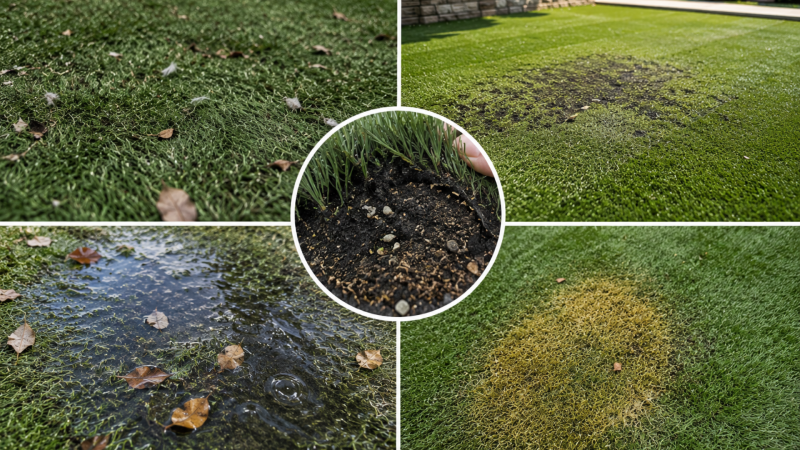
Odor is the most reliable sign that professional cleaning cannot wait. A smell that returns within 24 hours of rinsing means bacteria have colonized the infill layer, not just the fiber surface. Rinsing only dilutes surface contamination temporarily; the infill reservoir remains active.
Matting is the second visible signal. When turf fibers no longer spring back after foot traffic, infill particles have shifted or compacted enough to lose their support function. Matting visible across more than 10% of a turf section is a flag for fiber brushing and possibly infill redistribution, which are professional procedures.
Slow drainage is an early warning most homeowners miss. Artificial turf is designed to drain at 30 inches per hour or more, according to turf installation standards. When you see standing water after light rain, debris and fine particles have begun blocking the drainage layer, typically 12 to 18 months into a neglected maintenance cycle.
Discoloration in localized patches, particularly yellowish or gray tones on green turf, signals a combination of UV degradation and bacterial staining. UV alone does not create patches; that pattern indicates an organic contamination source underneath.
Infill contamination is invisible at the surface until it reaches saturation. Uric acid bonds to silica infill within 72 hours of contact. After that window closes, standard enzymatic sprays applied from above cannot penetrate deeply enough to break the bond. Professional extraction equipment agitates infill from below while simultaneously applying treatment, which is why DIY products applied at the surface produce diminishing results over time.
Between professional visits, an enzyme-based infill treatment such as Bio-Guard+ can slow uric acid bonding if applied within 24 to 48 hours of contamination. Bio-Guard+ is formulated to penetrate the top 2 inches of infill, which covers the majority of early-stage uric acid deposits before they fully crystallize. It does not replace professional extraction for established contamination.
If your turf shows parasite-related contamination from dogs, the cleaning process for that specific issue differs from standard odor treatment. See this guide on how to clean artificial grass to remove dog worms for a step-by-step approach.
Remove a small amount of infill from a contaminated area with a spoon, place it in a sealed plastic bag, and let it sit in direct sun for 30 minutes. Open and smell. If the odor is significantly stronger than the surface smell, contamination has reached infill depth and requires professional extraction.
Key Takeaways: Warning Signs
The next section explains what happens financially and structurally when these signs are ignored.
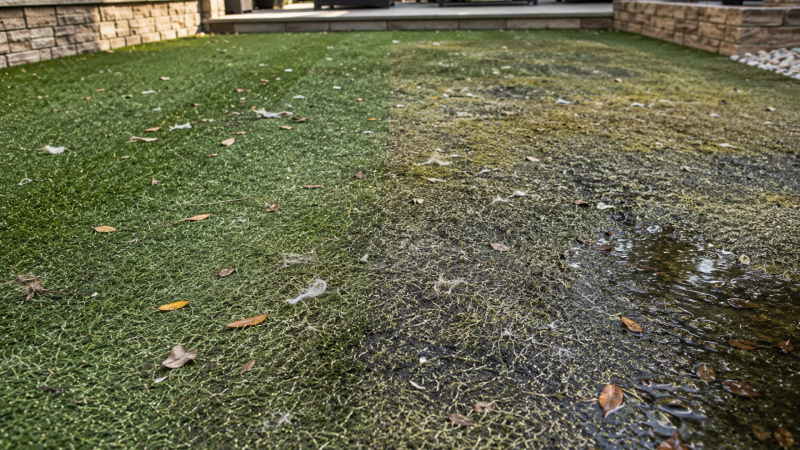
Skipping professional cleaning does not just affect odor; it changes the cost math of owning artificial turf entirely. A routine professional cleaning in the Dallas area runs $0.35 to $0.60 per square foot. A turf Reset service, needed when infill has compacted to the point of drainage failure, runs approximately $1.50 per square foot. One skipped year on a 500-square-foot lawn can convert a $175–$300 maintenance visit into a $750 remediation.
Turf replacement is the worst-case outcome. Installed artificial turf costs $8 to $20 per square foot in the DFW market, depending on pile height, infill type, and labor. A 500-square-foot lawn that reaches replacement threshold costs $4,000 to $10,000 to reinstall. Regular professional cleaning, by contrast, costs $175 to $300 per visit for the same area.
Infill compaction follows a timeline that accelerates with heat and pet use. In the first 6 months without cleaning, infill begins to pack unevenly under high-traffic paths. By 12 months, drainage rates measurably slow as debris fills the gap between infill particles. Between 12 and 18 months, compaction in high-use areas becomes semi-permanent, meaning standard brushing and rinsing can no longer restore the original infill depth distribution. with year-round pet use and no winter dormancy period, professional assessment is required to determine whether Reset service or replacement is the correct path.
| Option | Cost per Sq Ft | What It Addresses |
| DIY rinse + enzyme spray | $0.02–$0.10 | Surface bacteria and odor only |
| Professional cleaning | $0.35–$0.60 | Infill-depth extraction + deodorizing |
| Reset / remediation | $1.50 | Compacted infill + drainage failure |
| Full turf replacement | $8.00–$20.00 | End-of-life or irreparable damage |
For households with pets, Pet-Guard+ is a between-visit treatment designed to slow infill compaction and neutralize ammonia at the source. Pet-Guard+ uses a dual-enzyme formula: protease breaks down protein waste, and urease targets uric acid crystals. This extends the effective period between professional cleanings by reducing active bacterial colonies in the top infill layer.
Stand on the turf in one spot and jump lightly twice. If your feet sink noticeably or the turf feels “dead” underfoot with no spring, the infill has compacted below the fiber root zone. That is the physical sign that drainage is already compromised and professional assessment is due.
Key Takeaways: Cost of Skipping
The final section covers how to build a cleaning schedule that accounts for Dallas conditions specifically.
Between professional cleanings, a consistent DIY routine extends the effective cleaning interval. Brush cross-grain with a stiff-bristle broom every 2 weeks to prevent fiber matting and redistribute infill. Rinse with a garden hose after each pet use, specifically aiming for 60 seconds per contaminated area, to dilute surface uric acid before it bonds. Apply an enzyme-based infill treatment monthly during summer (May through September) and every 6 weeks during cooler months.
| Situation | DIY Between Visits | Professional Interval |
| No pets | Rinse monthly, brush quarterly | Every 6 months |
| 1–2 dogs | Rinse after each use, brush bi-weekly | Every 3–4 months |
| 3+ dogs | Rinse daily, enzyme treatment monthly | Every 6–8 weeks |
| Commercial / HOA | Property team rinse weekly | Monthly |
| Sports field | Post-event rinse and drag | Monthly or post-event |
In our 25+ years serving texas, the most common turf failure we see is not from a single missed cleaning. It is from homeowners extending a 3-month schedule to 6 months because the turf “looked fine.” Infill contamination is not visible at the surface until the infill layer is near saturation. By the time odor is noticeable from a standing position, bacteria have already colonized a significant portion of the infill mass and a Reset service is likely needed rather than routine cleaning.
Before agreeing to a maintenance plan, ask three specific questions: What depth does the cleaning equipment reach? Does the service include infill redistribution or only surface extraction? What is the drying time, and can the turf be used on the same day? A professional cleaning that reaches infill depth will require 2 to 4 hours of drying time. Any service completed in under 30 minutes on a full-size lawn is surface-only.
To set up a cleaning schedule or request an assessment for your Texas property, call ATM at 469-955-1262.
Key Takeaways: Building Your Schedule
Q: How often should I professionally clean artificial turf with two dogs in Dallas?
A: Every 3 to 4 months is the minimum recommended interval for Dallas homeowners with two dogs. Dallas summer heat above 105°F accelerates bacterial growth, which means the national guideline of every 6 months is not sufficient for DFW pet owners.
Q: Can I clean artificial turf myself instead of hiring a professional?
A: DIY cleaning (rinsing and enzyme spray) addresses the top 1 to 2 inches of fiber surface only. Professional equipment agitates and extracts infill at 3 to 5 inches of depth. Once uric acid bonds to infill at 72 hours, DIY products cannot break that bond without professional-grade extraction.
Q: Is once a year enough for artificial turf cleaning?
A: Once a year is adequate only for residential turf with no pets, minimal foot traffic, and no shade coverage. Any pet use, high foot traffic, or shaded areas that stay moist require more frequent service. In Dallas’s summer conditions, once-yearly cleaning for pet turf would allow 9 to 11 months of unaddressed bacterial accumulation.
Q: What is the best time of year to deep clean artificial turf in Texas?
A: March through May and September through November are the optimal windows. Professional treatments applied during those periods dry in 2 to 4 hours. In July and August, extreme heat extends drying time and can trap treatment agents in the infill, reducing effectiveness.
Q: Does Artificial Turf Maintenance (ATM) offer ongoing maintenance plans for Dallas and Fort Worth properties?
A: ATM offers routine maintenance plans for residential, commercial, HOA, and sports field turf across the Texas. Plans include infill-depth extraction, deodorizing, and fiber brushing on your chosen interval. Call 469-955-1262 or visit artificialturfmaintenance.com to discuss a schedule based on your specific turf type and use.
Q: How much does a quarterly professional turf cleaning cost in Texas?
A: Professional turf cleaning in the Fort Worth area runs approximately $0.35 to $0.60 per sq ft. A 500-square-foot lawn costs roughly $175 to $300 per visit at that rate. Quarterly service for the same lawn runs $700 to $1,200 per year, substantially less than a single Reset service at $1.50 per sq ft if infill compaction is allowed to develop.