
TL;DR
- What’s the real difference between DIY and professional cleaning? Professional equipment reaches infill depth a garden hose cannot.
- What do most guides miss? A garden hose runs 40 to 60 PSI versus professional equipment at 1,200 to 1,500 PSI.
- Is DIY cheaper? DIY supplies cost $50 to $150 upfront but cannot fix infill-depth problems at any price.
- When is professional service required? Odor, drainage, or matting that DIY brushing and rinsing fail to resolve.
QUICK ANSWER BOX
Professional turf cleaning vs DIY comes down to pressure and depth. A garden hose delivers roughly 40 to 60 PSI, reaching only the fiber surface. Professional equipment uses controlled 1,200 to 1,500 PSI with a wide-fan nozzle, reaching the infill layer where odor, bacteria, and compaction actually live. DIY works for light, frequent upkeep. Professional service is required for odor removal, infill decompaction, and warranty-safe deep cleaning.
The core gap between DIY and professional turf cleaning is pressure and depth, not effort or tools alone. A garden hose runs roughly 40 to 60 PSI, while professional equipment uses controlled 1,200 to 1,500 PSI to reach infill rather than just the fiber surface. DIY handles light, frequent maintenance well, but it cannot perform infill-depth tasks at any price point.
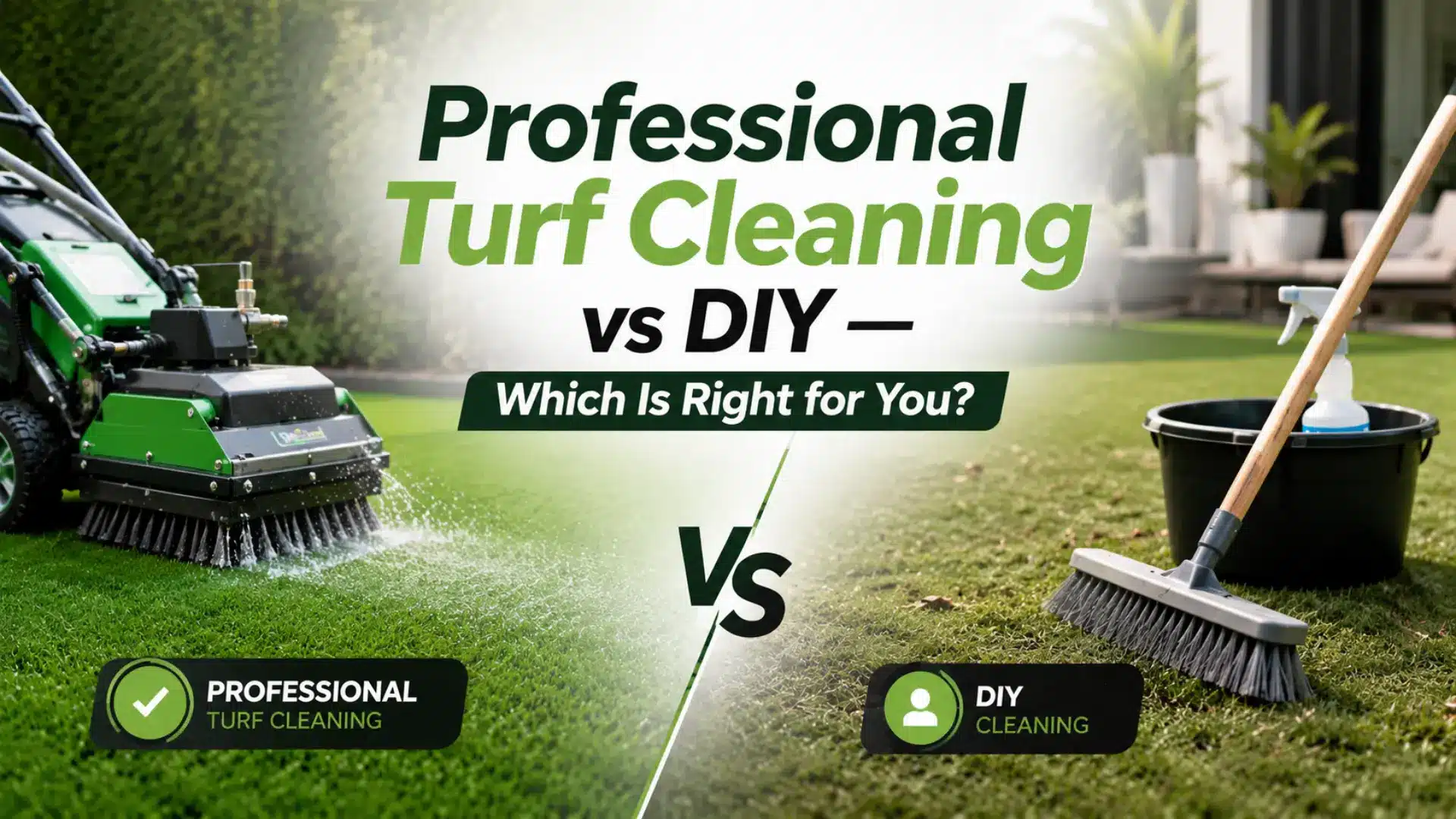
A garden hose generates roughly 40 to 60 PSI, which is enough to rinse surface debris but not enough to dislodge material bonded into infill. Professional equipment runs controlled 1,200 to 1,500 PSI through a wide-fan nozzle, designed specifically to reach infill depth without scattering it. Professionals also use power brushes and rotary groomers, mechanical tools that re-set flattened fiber bases rather than just lifting the visible blades, the same equipment behind our full-service turf cleaning. A garden hose and a stiff broom physically cannot reach below the top layer of fibers, regardless of how often they are used. This depth gap, not general effort, is what separates surface maintenance from actual deep cleaning.
That depth gap also shapes how much time DIY actually demands compared to a single professional visit.
Pet owners typically spend 2 to 4 hours per month on DIY turf upkeep, covering daily rinsing, weekly brushing, and occasional spot treatment. Non-pet households spend closer to 1 to 2 hours per month, mostly on debris removal and occasional brushing. A single professional Restore visit replaces several of these tasks at once, since power brushing, decompaction, and sanitizing happen in one pass rather than across multiple weekly sessions, see our routine maintenance plans for scheduled options that cut this time down further. For a typical 500 square foot yard, that visit takes roughly 1 to 2 hours on-site, condensing weeks of DIY effort into one appointment.
Time saved matters less if DIY effort accidentally creates new problems, which happens more often than most guides admit.
Consumer pressure washers above 1,300 PSI can dislodge infill if used without proper nozzle control, since DIY equipment lacks the wide-fan attachments professionals use to distribute pressure evenly. Bleach and harsh chemical cleaners do not break down uric acid, but they can strip the UV coating on fibers, and most manufacturer warranties explicitly exclude damage caused by these products. Texas heat above 100°F and storm-driven clay soil compaction combine to make DIY mistakes more costly here than in milder climates, since damaged turf already under thermal stress fails faster. Year-round pet use in Texas means there is no seasonal break to catch up on missed maintenance, unlike states with a true winter pause. These combined pressures are why small DIY errors tend to escalate faster on Texas turf specifically.
Given these risks, the next logical question is whether DIY actually saves money once mistakes are factored in.
DIY supplies, including a stiff brush, hose attachment, and enzyme spray, typically cost $50 to $150 upfront. A professional Restore visit costs $0.60 per square foot, which runs about $300 for a 500 square foot yard, full breakdowns for every service tier are on our pricing page. On pure upfront cost, DIY supplies pay for themselves within a single Restore visit. The comparison stops being purely financial at that point, though, since DIY cannot perform infill-depth tasks like decompaction or odor removal regardless of how much is spent on supplies.
Cost aside, the real test is whether DIY can fix the specific problem a reader is facing right now.
Pet odor cannot be permanently removed by DIY once uric acid bonds to infill within 72 hours in heat above 100°F, since surface rinsing never reaches that depth. An enzyme-based product like Bio-Guard+ can help pet owners manage odor between professional visits, but it works best on fresh urine, not infill already saturated for months. Matted fibers respond to DIY brushing only at the surface, since brushing cannot re-set the compacted fiber base the way mechanical reblooming equipment does. Drainage problems stem from compacted infill, which requires decompaction equipment rather than surface-level brushing or rinsing. Deep, set-in stains often involve contamination below the surface that a wipe or spray cannot reach, and infill replacement requires equipment to redistribute material evenly, since DIY attempts frequently create uneven, low-lying patches.
| Problem | DIY Works? | Why/Why Not |
| Pet odor | Partially | Fresh urine only; bonded uric acid needs enzyme depth treatment |
| Matted fibers | Surface only | Brushing lifts blades but cannot reset fiber base |
| Slow drainage | No | Compacted infill needs decompaction equipment |
| Set-in stains | No | Sub-surface contamination resists surface wiping |
| Infill replacement | No | DIY redistribution often creates uneven low spots |
Knowing which problems DIY can’t solve makes the decision between DIY and professional service much clearer.
Light, frequent maintenance like rinsing and weekly brushing is well-suited to DIY, since it prevents buildup without requiring infill-depth equipment. Any problem involving odor, drainage, matting, or staining that persists after DIY attempts signals an infill-depth issue that only professional equipment resolves. For Texas pet owners using turf year-round, the smartest approach combines daily DIY rinsing with quarterly professional visits. Our post on how often artificial turf should be cleaned breaks down exact intervals by pet count and use type, since neither approach alone keeps pace with constant exposure. An antimicrobial infill treatment like Pet-Guard+ can extend the gap between professional visits by limiting bacterial regrowth, but it does not replace the need for periodic deep cleaning. In our 25+ years serving Dallas and Fort Worth, the most common pattern we see is a homeowner who pressure washes turf at full residential PSI to fix odor, which dislodges infill and turns a simple Restore visit into a full Reset.
Once that decision is made, it helps to know exactly what a professional visit includes.
A standard Restore visit includes power brushing, infill decompaction, sanitizing, and odor treatment in a single appointment, typically priced at $0.60 per square foot. For yards needing only surface debris removal, a lighter Refresh visit at $0.35 per square foot covers brushing and cleanup without the deeper decompaction step. Artificial Turf Maintenance offers a free consultation to determine which service tier actually fits a given yard’s condition before any work begins. Call 469-955-1262 to schedule an assessment if DIY maintenance has stopped keeping up with your turf’s needs.
A: Yes, infill composition affects how equipment settings are adjusted during a professional visit. Sand-based infill generally requires gentler decompaction to avoid scattering fine particles, while rubber infill can typically tolerate slightly higher mechanical agitation. Technicians adjust pressure and brush settings based on infill type rather than using one universal setting. This adjustment is something DIY equipment generally cannot replicate since it lacks adjustable settings.
A: DIY time scales roughly with square footage, though not perfectly linearly. A small yard under 300 square feet might take under an hour weekly for brushing and debris removal. A yard over 1,000 square feet can take 2 to 3 hours for the same tasks due to more surface area and edge detail. Pet presence adds time regardless of yard size, since daily rinsing remains a fixed task either way.
A: Yes, multiple pets generally increase both rinsing frequency and the number of spots requiring attention. A single-pet household might manage with rinsing one or two zones daily. Multiple pets often mean rinsing several scattered zones, which can push monthly DIY time toward the higher end of the 2 to 4 hour range. This time increase is one reason multi-pet households more often choose professional maintenance plans.
A: No, mixing cleaning chemicals, especially bleach with other household cleaners, can create harmful fumes and is never recommended on any surface. Beyond safety, bleach specifically does not break down uric acid and can strip turf fiber UV coating. Most manufacturer warranties exclude damage caused by bleach or harsh chemical use. Enzyme-based products formulated specifically for turf avoid this risk since they are designed not to react with fiber coatings.
A: Vinegar is generally considered safe for occasional use on artificial turf fibers in diluted form. It does not contain the harsh compounds that strip UV coating the way bleach does. Repeated, undiluted use over long periods has not been well studied for turf-specific damage, so moderation is reasonable. Vinegar also does not break down bonded uric acid, so it should not be relied on as an odor solution.
A: HOA-managed common areas are typically maintained under the HOA’s own service contract rather than by individual residents. These contracts often include scheduled professional visits rather than relying on resident DIY effort. The budget allocated for shared turf maintenance usually covers Restore-level service rather than light Refresh-only upkeep, given heavier shared foot traffic. Specific responsibility always depends on individual HOA governing documents.
Not sure if DIY can fix your turf problem? ATM has served Dallas, Fort Worth, Austin, Houston, and San Antonio for 25+ years with transparent, tiered pricing. Call 469-955-1262 or visit artificialturfmaintenance.com/get-a-quote/ for a free consultation.